10-second summary:
- Google ads are a cost-effective way for med spas to generate fresh customer leads.
- Capture leads at the precise moment they are using Google to research treatments that you provide.
- Target audience by location to find leads near your clinic(s).
- Get a detailed breakdown of your ad spend and optimise campaign performance over time.
Be in zero doubt: Google Ads for med spas can transform your revenue and grow your business. You just need to know how best to use them.
Here’s (almost) everything you need to know.
Too busy? Let us cover your ads, and your ad spend too!
Hey, we’re Adbetter. We are an award-winning PPC agency that delivers high-quality leads for healthcare businesses that are hungry for growth. No more chasing dead ends. Just a predictable stream of new leads and fresh revenue. And with our performance pricing, our fees are tied to the results we deliver. Book a strategy call and let us explain.
“Adbetter have proven to be a rare find – an agency that focuses on ROI for their clients as opposed to metrics that may or may not impact your bottom line. I am from a digital marketing background myself and understand how some agencies can keep clients positive through claiming progress on things that don’t actually translate into ROI.
The team at Adbetter are solely focused on returns for their clients. In my experience they are methodical and iterative in their approach and push back when they feel the data is saying something different to what we to do next as a company, which is exactly what you want from a competent digital marketing agency. This is why we work with them and I think, in large part, why we have seen a return on our investment.”
– Steve Whitehouse, Patient Facilitator, KP Surgical
An intro to Google Ads for med spas
We’ll go out on a limb and assume you’ve searched Google before. So you’re familiar with the sponsored listings at the top of the search results. They’re Google Ads. And they are great for driving lead generation for healthcare businesses.
You can also advertise with Google via the Google Display Network – a vast estate of websites, mobile apps and more. However, for this article we’ll focus on search. That’s where the big and juicy opportunities are for med spas in terms of revenue generation.
But hey, if you’re interested…
Getting results from Google display ads for lead generation
Why do we love Google Ads for med spas?
Done well, Google Ads smash open the door to fresh leads and enhanced profits. Here are three reasons why it’s such a good platform for med spas.
- It’s accountable. You only pay when someone clicks your ad. And why would someone click unless they were at least partially interested in your services? Every penny is accounted for in the performance analytics.
- It captures intent. You capture leads at the precise moment they are searching for the med spa expertise that you provide.
- It’s easy to control your spend. You get options to automate daily, weekly, monthly or maximum budgets per campaign. And you can freeze your spending anytime you need to.
Google isn’t your only option
Sure, we love Google Ads for med spas. That’s because it’s usually the easiest pay per click platform to start generating revenue. But it’s not your only option.
Here’s another article to get tabbed up.
Med spa Facebook ads: getting results, driving revenue
How much do Google Ads for med spas cost?
That’s a good question. One without a simple answer.
In short: it depends.
With search ads, cost per click (CPC) is driven by a dizzying array of variables that are in constant flux. These include the relevance of your ad, your quality score (more on that later) and the industry or niche you are targeting. The more competitive the industry, the more expensive the keywords.
When setting your budget, Google will tell you how many clicks you can expect for your chosen target keywords. It’s worth remembering though. With Google Ads you only pay when someone actually clicks your ad and comes through to your landing page. There’s a lot to like about that. And it’s why Google Ads is such a powerful marketing tool.
One more thing? You can reduce your CPC by following best practice. And the same things that bring your CPC down will make your ads more likely to convert. Win, win. You’ll find some tips to help you smash it later in this article.
Rules and regulations for Google Ads
There are strict rules relating to the advertisement of certain med spa products and procedures. These rules differ from one state to another – and indeed from one country to the next.
That’s why it’s always best to do your research. For the most accurate and up-to-date information, consult the American Med Spa Association (AMSPA) and your state’s regulating board (usually the medical board).
For now, here are some common regulations you should be aware of when creating your med spa ads.
- You cannot target anyone under the age of 18.
- Treatments – including the potential risks – must be accurately described and all claims must be verifiable. No embellishing the potential results or making sensationalist claims.
- You cannot be perceived to be rushing your audience into a decision. Promotions must have a timeframe that’s long enough for your audience to make a balanced decision.
- Treatments that use fat dissolvers must use licensed products that are approved by the Food and Drug Administration.
- Unless you have a LegitScript certification, you can’t advertise Botox, Dysport, Xeomin, Daxxify, Jeuveau or other injectables using their brand names. These prescription-only medications can only be promoted on social media and websites by licensed pharmacies and authorised resale companies.
- Google doesn’t allow retargeting campaigns related to healthcare. It’s all to do with privacy. You can find out more – and discover certain alternatives – in our article here.
If you want to know more, Google’s policies for healthcare advertising are right here.
Okay. Let’s look at some best practice for your Google Ads campaigns.
Google Ads for med spas: setting up your campaign
The Google Ads interface is slick and intuitive. You are likely to be able to begin getting results with no prior experience. (Especially if you continue reading this guide.)
Here’s how to get set up.
Create your account
Let’s start with the basics. To create Google Ads, you need to set up an account. Head to ads.google.com to sign up. Your account is where you will control billing, admin permissions and, of course, your ad campaigns.
Campaigns and ad groups
Each of your campaigns can be divided into different ad groups, where you’ll set your budget and targeting. Each ad group will have a different set of keywords that you can use to focus on a specific treatment, ailment or audience – with your ads triggered when someone searches for keywords that you have specified.
Think about target locations and niches
Once your account is up and running, take some time to think about the treatments and procedures that you want to promote, as well as the type of people you are advertising to.
Create a list of neighbourhoods and niches that you’d like to target. These will eventually make up your ad groups.
Go granular, improve quality score
Instead of creating a generic ad campaign about your clinic, it’s best to create individual ads for each service or treatment that you want to promote. These should drive traffic through to webpages that are highly relevant to each ad – focusing on that specific treatment.
Relevance is a big thing for Google. And when you have it, you improve your Quality Score. This is a measure of how relevant your ads are to your website. And when Google identifies that your landing pages are relevant to your keyword bids, you will get a higher Quality Score and pay less per click. Nice.
- Private clinic ads: what are the best treatments to promote via PPC?
- Body contouring ads: 11 tips for consistent ROI
- How to maximise revenue from your liposuction advertising
- Supersize your revenue with pay per click CoolSculpting ads
- Laser hair removal advertising: finding the best strategy
Keyword research – and the need to consider intent
Next it’s time to think about the keywords that you want to target. This is all about putting yourself in your potential client’s shoes and thinking about what they might search for to find the med spa services that you provide.
Remember there are many different searches that can signal an intent to use med spa services. For example some people might Google the name of a procedure: abdominoplasty in Houston. Others might be searching for an answer to a problem: “how to get rid of saggy skin on abdomen”.
Google’s free keyword planner can help you narrow your focus and offer insight on search volume, competition and the potential cost for the keywords you may want to pursue.
Google Ads for med spas: creating a campaign
From your Google Ads account, click the blue plus sign to start creating your campaign.
Set your campaign objective
The first thing you’ll do is choose a campaign objective. For lead generation – surprise, surprise – we’d recommend the ‘leads’ objective. Here’s a quick summary of each objective.

- Sales: Focuses on increasing the sales and profitability of your products or services. Bidding strategies are aimed at clicks, assets and ads that prompt purchases.
- Leads: Aims to drive leads for your business by capturing customer information through form submissions.
- Website traffic: Emphasises driving traffic to your website.
- App promotion: Designed for creating a streamlined journey to encourage installs of a mobile app.
- Awareness and consideration: Aimed at boosting the visibility and recognition of your brand.
- Local store visits and promotions: Designed to drive footfall to bricks-and-mortar locations.
Set your campaign type
Choose a Search campaign. That’s how we’ll get your ads displaying in the world’s most famous search engine.
Choose (and exclude) locations
If your med spa is based in Houston there’s very little point serving your ads to people in Hollywood. Think about how far people would be willing to travel for your services and set your location parameters accordingly.

Creating your ad groups
Remember what we were saying earlier about considering the different niches that you want to promote? Your ad groups is where you segregate them.
Specify your keywords
Next it’s time to list the keywords that you want your ads showing up for. You’ll find this easy because you did your keyword research when we mentioned it earlier, right?
Some example keywords:
- abdominoplasty in houston
- how to get rid of saggy skin
- brow lift in houston
Understanding keyword match types
Google lets you define how tightly it matches your keywords. For example, you can set it to display your ad for keywords that are loosely related to yours. Or you can insist that your ad is only served when your exact keywords are searched for.
- Broad match: Your ad will be displayed for all keywords that are similar to the ones you specified. This is the default setting.
- Phrase match: Your ads are shown in search queries that contain the exact phrase or a close variation.
- Exact match: Your ads will only be served when someone searches your exact keywords, with no additional words.
There’s no right or wrong answer here. It all depends on the keywords you have chosen and the search volumes your keywords attract. Exact match allows you to be highly targeted. Whereas broad match can enhance your exposure – although potentially serves your ad to people with less interest in your services.
Experiment and let your campaign performance data guide you.
What about negative keywords?
Just as you can define keywords that you want your ad to be shown for, you can define keywords that prevent your ad from being shown.
Why would you want to do this? Let’s say you have an ad based on the keyword “med spas in houston”. You’ll want to make sure people searching for “med spa jobs in houston” are excluded from seeing your ad.
Specifying “jobs” as a negative keyword reduces the chances of paying for a click that won’t create new business. Think carefully about other words you can exclude to weed out people who have no intent on using your med spa services.
Google med spa ads: creating your first ad
Now it’s time to start actually creating your ads: writing the copy and firing it out into the big wide world of Google search.
Where are you sending your leads?
To start with, you need to provide a URL that your ad will drive traffic to. This should be a landing page that’s specific to your ad group. (More on landing pages shortly.)
You will also be prompted for a display path. This is simply the way you want your URL to look in your ad.
For instance, your final URL might be something like:
http://www.magic-medspa.com/landing-pages/houston/abdominoplasty
But you could style it as:
magic-medspas.com/abdominoplasty
Much neater.
Crafting your headlines and descriptions
Fetch your thesaurus. It’s time for some wordsmithery.
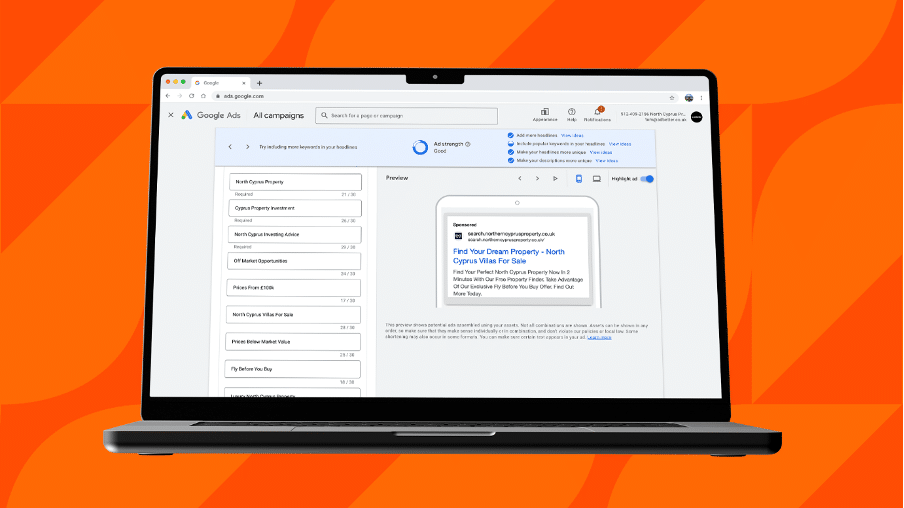
Google Ads comprise one headline and two descriptions.
- 1x headline (30 characters)
2x descriptions (90 characters each)
An important thing to note is that Google ultimately creates your ads for you. You feed it variations of headlines and descriptions – and it finds the best combinations for driving leads to your business.
Here are some tips for attention-grabbing ad copy.
Remember your reader
Remember there’s a real person behind every search. Speak directly to your lead using “you”-focused messaging. Think about what this person might be feeling: their doubts, anxieties, motivations and ambitions. Try to put yourself in your ideal client’s position and write accordingly.
Include your keywords in your copy
While not essential, it’s a good idea to include the keywords you are targeting in your ad copy. These words will then be displayed in bold when your ad is served.
Communicate with clarity
You have milliseconds to get your message across. Be concise. Keep it relevant. Write with clarity.
Should you use assets?
Assets are pieces of additional information that can be included in your ad. We’d advise steering clear of additional links to your website. You want your ad to have a singular focus – driving all clicks through to your landing page.
However, you may want to take the option to include your phone number – which people can click straight from the Google search results to call you. You can also include the location of your med spa, which can help you stand out to a local audience.
Beyond the click: optimising your landing pages
When you’re paying for every click, it’s worth thinking carefully about what happens next.
Landing page best practice
You should have a specific landing page that’s highly relevant to each of your ad groups. Landing page design is a huge subject in its own right. But here are some quick tips.
Take your lead on a diagnostic journey
The more information you can gather about your leads, the better. Think about creating a landing page questionnaire that prompts your lead to choose their own diagnostic path.
Ask them questions about their ailment or chosen outcome and you can guide them towards the most appropriate course of action. Enquire about the motivations behind their decision to seek treatment.
Not only does this engage your leads. It gives your sales team invaluable information on lead quality – allowing them to quickly identify the leads that are worth following up and enabling them to personalise lead nurture activities.
This is a strategy we used ourselves to boost UK Vein Clinic’s leads – almost doubling their customer base in the process.
Find out how in the article below.
Adbetter: officially an award-winning PPC agency
Take care over your branding
People are discerning when it comes to making decisions about their health. Your branding must be carefully considered: projecting a business that’s professional, credible and most importantly safe.
Sloppy branding will be conflated with sloppy service. And you don’t want sloppiness when scalpels are involved.
Of course, the need for a professional feel to your brand needn’t come at the cost of differentiation or creativity. Lots of healthcare branding is basically identical, which leaves wriggle room to create something that’s a little more unique to your med spa’s values and personality.
Make use of before and after images
So often the go to of cosmetic marketing, before and after shots are banned across many PPC platforms. Not so with Google. However there are certain guidelines to follow.
You need to use the same photographic process for both shots. That means shooting from the same distance. Using the same camera settings. Making sure the lighting in the room is the same. The effort will be worth it when you have a catalogue of photography that perfectly demonstrates the results you have achieved for your clients.
And remember: you are permitted to edit your images – but you must not edit any part of the image that relates to the treatment being promoted.
Clinical photography for aesthetic professionals
Embrace social proof
When it comes to med spa marketing, customer testimonials are compelling. Many healthcare decisions require a lot of customer consideration. Anything that helps to reduce uncertainty and bring more clarity to the decision-making process is going to work in your favour.
You want your customer testimonials to feel as natural and authentic and unforced as possible. If you are filming your customer, consider positioning the camera off to the side – so the subject isn’t staring straight down the lens. And whether written or recorded, try to gather customer testimonials that show how you overcame a customer’s obstacles or doubts before obtaining the desired results.
Showcase your credentials
More than anything else, your leads need to feel they can trust you. They want reassurance that you are a safe pair of hands. So make sure you signpost professional qualifications, certifications and awards as well as membership of relevant industry or regulatory bodies.
Google Ads for med spas: setting your campaign budget
The final step in creating your campaign is to set a campaign budget. There is lots of freedom to experiment here. You can set daily or weekly budgets, set rules around seasonality. Got it wrong? Don’t worry. You can change your settings anytime within a matter of clicks.
Here are the main bidding strategies to be aware of.
- Maximise clicks: Google will aim to bring you the most clicks possible for your daily budget.
- Maximise conversions: Google will aim to get the most conversions possible for your daily budget.
- Target CPA (cost per acquisition): Like the above, but Google tries to get as many conversions as possible within CPA parameters that you set.
Google Ads for med spas: tracking and optimising your campaign

Your willingness to monitor and act on your performance data can be the difference between success and failure. No overstatement. You should be constantly on the lookout for what’s working – and what isn’t – so you can iterate your campaigns and drive increased performance and efficiency over time.
Set up conversion tracking
You need to tell Google what represents conversion for your campaign. Under “Tools and Settings,” go to “Conversions” to create a new conversion action.
This will often be measured when a visitor fills out a contact form or signs up on your website, but you can also measure calls.
Continually monitor metrics
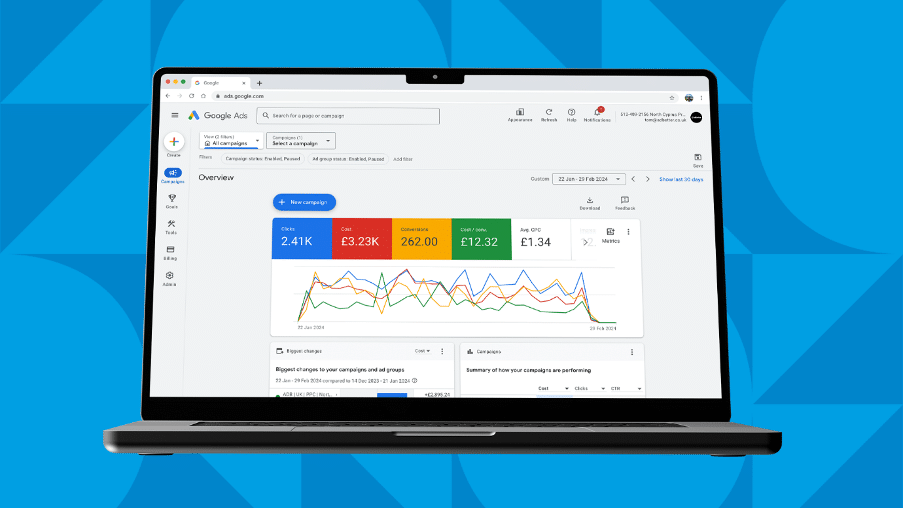
Your ads dashboard will provide you with lots of data on how your ads are performing. Many businesses pay only cursory attention to it. But this data holds the secrets that will help you crack the code of campaign performance.
Is there something you are saying in your messaging that is encouraging clicks? Is one location dramatically outperforming another? When you know what’s getting results, you can double down on those tactics – creating more ad variants based on what’s working and ditching the stuff that isn’t. Test, repeat, test, repeat.
This is the recipe for increased performance – and enhanced revenue.
Review your campaign search terms
Regularly review the search terms that trigger your med spa ads to show up. This insight helps you to optimise your keyword and negative keyword lists so that your ads only appear for the most relevant and potentially lucrative queries.
Let us take care of it for you…with fees tied to results
As you can see, there’s lots of work that goes into a Google Ads campaign that generates serious revenue. We are an award-winning pay per click specialist that can take care of everything for you. Delivering you fresh leads and new clients – week after week, month after month. And with our performance pricing, our fees are tied to the results we deliver.
Sounds good? Find out more or book a strategy call.
Frequently asked questions
Many experts cite three main benefits of using Google ads for med spas: accountability – you only pay when someone clicks; ease of finding customers – you are reaching out at the point of need; budgeting – it’s easy to control your ad spend.
In short: it depends. Cost per click is driven by an array of variables that are in constant flux. When setting your budget, Google will tell you how many clicks you can expect for your chosen target keywords. Alternatively there are some pay per click experts – such as Adbetter – who tie their fees to the results they deliver and manage your campaigns for you.
There are strict rules relating to the advertisement of certain med spa products and procedures. These rules differ from one state to another – and indeed from one country to the next. Common regulations include bans on targeting people under the age of 18, making sure treatments – and potential risks – are accurately described and avoiding any sense that you are rushing your audience into a decision with marketing tactics like limited time offers.
Before and after shots are allowed to be used in Google ad campaigns for med spas. However you need to use the same photographic process for both shots – shooting from the same distance and angle, for example. You are permitted to edit your images – but must not edit any part of the image that relates to the treatment being promoted.
Instead of creating a generic ad campaign about your clinic, it’s best to create individual ads for each service or treatment that you want to promote. These should drive traffic through to webpages that are highly relevant to each ad – focusing on that specific treatment. It’s usually more cost-effective to promote the treatments where you make the highest margin.
Think about what potential clients might search to find the med spa services that you provide. For example some people might search the name of a procedure – such as ‘abdominoplasty in Houston’. Others might search for an answer to a problem – such as ‘how to get rid of saggy skin on abdomen’. Google’s free keyword planner offers insight on search volume, competition and potential cost.
Just as you can define keywords that you want your ad to be shown for, you can define keywords that prevent your ad from being shown. Let’s say you have an ad based on the keyword “med spa in houston”. You’ll want to make sure people searching for “med spa jobs in houston” are excluded from seeing your ad. Specifying “jobs” as a negative keyword reduces the chances of paying for a click that won’t create new business.
You need to tell Google what represents conversion for your campaign. Under “Tools and Settings” in your ads dashboard, go to “Conversions” to create a new conversion action. This will often measure form completions or sign-up actions, but you can also measure calls.
A successful Google ads campaign requires a lot of time and knowledge. Working with a specialist – such as Adbetter – can help you get the results you want faster.
You might also like to read:
- Med spa ads: 12 tips to drive rapid growth
- Med spa Facebook ads: getting results, driving revenue
- Cosmetic surgery advertising: what’s the best way to grow your business?
- Cosmetic surgery lead generation: 4 big tips to enhance your results
- Cosmetic surgery PPC: skyrocketing leads through Google
- Plastic surgery PPC: 13 tips for bigger, better returns